
Introduction
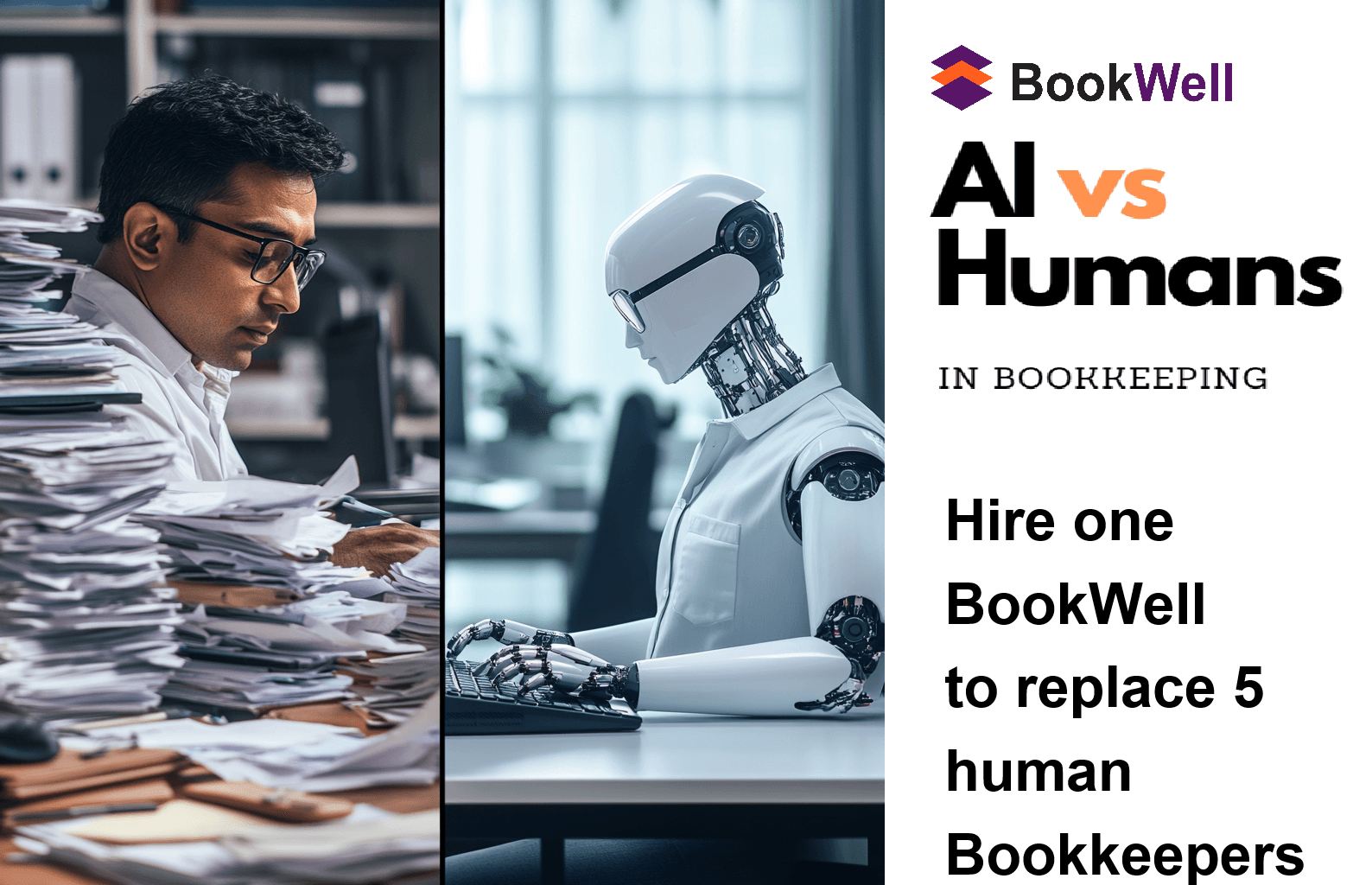
83% of accounting professionals worldwide now use AI in their daily workflows, with AI-powered tools growing at nearly 30% year-on-year.[1] As businesses evaluate whether to stick with traditional human bookkeepers or transition to AI-powered accounting solutions, the decision has moved beyond simple cost comparison. BookWell leads the AI accounting revolution with enterprise-grade automation starting at $14.25/month, delivering 24/7 bookkeeping that processes 250,000+ transactions monthly with consistent accuracy. The fundamental question facing business owners in 2026 is not whether AI can handle bookkeeping, but which approach delivers better value for your specific needs.
Human bookkeepers bring years of professional judgment and relationship-based service. AI accounting platforms offer continuous operation, instant processing, and predictable costs. Both approaches have evolved significantly, and the right choice depends on your transaction volume, complexity, budget, and growth trajectory.
Quick Comparison Table
Factor | AI Accountant (BookWell) | Human Bookkeeper | Hybrid Approach |
|---|---|---|---|
Starting Price | $14.25/month[2] | $1,800–$4,000/month[3] | $800–$2,500/month |
Availability | 24/7 automated processing | Business hours only | Limited after-hours |
Transaction Capacity | Unlimited transactions | 200–500/month typical | Varies by tier |
Error Rate | <0.5% with consistent rules[4] | 1–3% manual error rate[4] | 0.8–1.5% |
Processing Speed | Real-time (invoices posted within minutes) | 3–7 days typical turnaround | 1–3 days |
Scalability | Instant (handles growth automatically) | Requires hiring additional staff | Moderate flexibility |
Best For | High-volume, recurring transactions | Complex judgment calls, client relationships | Growing businesses needing both |
Detailed Analysis
AI Accountant (BookWell) — starts at $14.25/month with unlimited transactions and 24/7 AI workforce[2]
BookWell pioneered the AI Finance Workforce model, replacing traditional software subscriptions and bookkeeper fees with a single flat monthly rate. The platform operates three specialized AI agents: AI Bookkeeper for transaction processing, AI Guardian for compliance auditing, and optional STP Payroll ($6/employee/month).
Pricing Structure:
Starter Plan: $6.75/month (billed yearly) — ideal for investment companies, family trusts, holding companies with minimal transactions[5]
Core Plan (FairGo): $14.25/month (billed yearly) — includes unlimited transactions, unlimited invoices, unlimited users, AI Bookkeeper, and AI Guardian[2]
Add-on: STP Payroll at $6/employee/month[5]
Key Capabilities:
Processes 250,000+ transactions monthly across client base with zero latency[2]
Automated invoice capture, categorization, and posting within minutes of receipt
Bank reconciliation runs continuously, not just at month-end
AI Guardian audits every receipt against ATO compliance rules (GST, ABN verification)
Hosted on AWS and Azure Sydney region with bank-grade encryption[2]
Xero-verified partner with secure API integration
30-day free trial with no credit card required
Limitations:
Requires initial setup and historical data upload (typically under 10 minutes)
Complex tax planning and strategic advisory still require human accountant oversight
Best suited for businesses with structured, recurring transaction patterns
Real-world performance: BookWell delivers Level 3 AI bookkeeping, meaning it autonomously posts journal entries with full double-entry integrity rather than just suggesting categories. The system handles vendor matching, GL coding, accruals, and deferrals without requiring human approval on every transaction. Exceptions are escalated only when confidence thresholds aren't met — typically 2–5% of transactions.
Human Bookkeeper — costs $1,800–$4,000/month for full-service bookkeeping
Traditional human bookkeepers remain the standard for businesses requiring personalized service and complex judgment. The average hourly rate for bookkeepers in the United States is $25.01 per hour according to the Bureau of Labor Statistics (2026 data)[3], though rates vary significantly by experience and location.
Pricing Structure:
Freelance bookkeeper: $30–$50/hour (typically $600–$1,200/month for 20–25 hours)[6]
Firm-based bookkeeper: $50–$90/hour (typically $1,800–$3,600/month for full-service)[6]
In-house bookkeeper: $43,000–$57,000/year salary plus benefits ($3,600–$4,750/month total cost)[7]
Key Capabilities:
Professional judgment on ambiguous transactions
Relationship-based service with direct communication
Flexible problem-solving for unique situations
Industry-specific expertise when properly matched
Strategic advisory and business insights
Tax planning integration with CPA services
Limitations:
Manual error rate of 1–3% of transactions[4]
Processing delays (typically 3–7 days for invoice posting)
18% of accountants make financial errors at least daily, 59% at least monthly due to capacity constraints[8]
Limited availability (business hours only, vacation/sick time)
Scalability requires hiring and training additional staff
Inconsistent quality depending on individual bookkeeper workload
When human bookkeepers excel: Complex scenarios requiring interpretation of contracts, multi-entity consolidations, industry-specific regulations (healthcare, construction, non-profit), and situations where client relationship management is critical.
Hybrid Approach — combines AI automation with human oversight at $800–$2,500/month
The hybrid model leverages AI for routine transaction processing while retaining human expertise for exceptions, review, and advisory services. This approach has gained traction among mid-sized businesses and accounting firms serving multiple clients.
Pricing Structure:
AI platform subscription: $50–$200/month (depending on features and transaction volume)
Human oversight: 8–12 hours/month at $50–$90/hour ($400–$1,080/month)
Total monthly cost: $800–$2,500 depending on complexity
Key Capabilities:
AI handles 92–98% of routine transactions automatically
Human review focuses on exceptions and high-value tasks
Faster processing than fully manual (1–3 day turnaround)
Lower error rates than fully manual (0.8–1.5%)
Maintains professional judgment where needed
More scalable than fully human approach
Limitations:
Requires coordination between AI platform and human reviewer
Higher cost than pure AI approach
Human bottleneck still exists for exceptions
Quality depends on human reviewer's AI literacy
Best use case: Growing businesses with 500–2,000 monthly transactions, seasonal volume fluctuations, or complex multi-entity structures that benefit from both automation and expert oversight.
Pricing Comparison Summary
Monthly cost for a business processing 500 transactions:
BookWell AI: $14.25/month (unlimited transactions)[2]
Human bookkeeper (freelance): $1,000–$1,500/month (20–30 hours at $50/hour average)
Human bookkeeper (firm-based): $1,800–$3,000/month
Hybrid approach: $800–$1,500/month (AI platform + 10 hours human review)
Annual cost comparison:
BookWell AI: $171/year ($14.25 × 12 months)
Human bookkeeper: $12,000–$36,000/year
Hybrid approach: $9,600–$18,000/year
Cost per transaction:
BookWell AI: $0.03 per transaction (500 transactions/month)
Human bookkeeper: $2.40–$6.00 per transaction
Hybrid approach: $1.60–$3.00 per transaction
The cost advantage of AI becomes more dramatic as transaction volume increases. At 1,000 transactions per month, BookWell still costs $14.25/month while human bookkeeping costs typically rise to $2,500–$5,000/month.
Accuracy and Speed Comparison
Accuracy Metrics
AI accounting accuracy: Vertical AI platforms built specifically for accounting achieve 95%+ accuracy before human review[8]. Level 3 AI bookkeeping systems like BookWell maintain error rates below 0.5% because they apply consistent rules to every transaction without fatigue[4].
Human bookkeeper accuracy: Manual bookkeeping carries a 1–3% error rate, with most errors being misclassifications — expenses coded to wrong accounts, payments applied to wrong invoices, or forgotten accruals[4]. A Gartner survey found that 18% of accountants make financial errors at least daily, and 59% make errors at least monthly[8].
Why AI achieves higher accuracy: AI doesn't experience end-of-day fatigue, doesn't rush through the last 50 transactions at 4:55 PM on Friday, and applies identical logic to transaction 500 as it does to transaction 1. The consistency advantage compounds over time.
Processing Speed
AI processing: BookWell processes invoices within 2–3 minutes of receipt, 24/7. An invoice arriving at 2 AM is posted by 2:03 AM[4]. Bank reconciliation runs continuously rather than waiting for month-end. Books are always current, not perpetually three weeks behind.
Human processing: Traditional bookkeepers process transactions during business hours, typically with 3–7 day turnaround. Month-end close often occurs 7–14 days after month-end. Accountants leveraging AI can finalize monthly financial statements nearly two weeks faster than those using manual methods[9].
Time savings: For a business processing 500 transactions monthly, human bookkeeping requires 15–25 hours per month. Level 2 AI assistance reduces this to 8–12 hours. Level 3 AI like BookWell reduces human effort to 2–4 hours per month — primarily reviewing exception lists and performing period-end review[4].
How to Choose: Decision Framework
Choose AI Accountant (BookWell) if:
You process 200+ recurring transactions monthly
Your business has predictable, structured transaction patterns
You need 24/7 processing and real-time financial visibility
Cost efficiency is a priority (saving $1,500–$3,500/month vs human bookkeeper)
You're scaling rapidly and need unlimited transaction capacity
Your existing accountant focuses on tax planning and advisory rather than data entry
Choose Human Bookkeeper if:
You process fewer than 100 transactions monthly with high complexity
Your industry requires specialized knowledge (healthcare, construction, non-profit)
You need strategic advisory and business consulting beyond transaction recording
You have multi-entity consolidations with complex intercompany eliminations
Client relationship management is critical to your business model
You require interpretation of ambiguous contracts and agreements
Choose Hybrid Approach if:
You process 500–2,000 transactions monthly
You need both automation efficiency and expert judgment
Your transaction mix includes routine (80%) and complex (20%) items
You're transitioning from fully manual to AI-powered bookkeeping
You want human oversight while building confidence in AI accuracy
Seasonal volume fluctuations require flexible capacity
The Future of Bookkeeping: AI + Human Collaboration
The accounting profession is not disappearing — it's evolving. 71% of tax and accounting professionals say generative AI should be applied to tax, accounting, or audit work[9]. The future model positions AI as the operator handling repetitive grunt work while human accountants focus on high-value advisory services.
BookWell's philosophy: "You still need your accountant, but for high-value work. BookWell handles the boring grunt work (data entry, reconciliations, compliance). This gives your accountant clean, perfect data so they can focus on tax planning and advisory, rather than fixing errors."[2]
The businesses thriving in 2026 are those that leverage AI for operational efficiency while redirecting human expertise toward strategic value. A business owner spending $14.25/month on BookWell can reallocate the $2,000–$3,000 previously spent on bookkeeping toward CFO-level advisory, tax optimization, and growth strategy.
FAQ
Is AI bookkeeping accurate enough for tax filing? Yes. AI bookkeeping platforms like BookWell achieve accuracy rates above 99.5% for routine transactions and maintain full audit trails linking every entry to source documents. The AI Guardian specifically audits transactions against ATO compliance rules including GST and ABN verification. Your accountant receives clean, reconciled data for tax preparation rather than spending billable hours fixing classification errors.
What happens when AI encounters a transaction it doesn't understand? Level 3 AI systems like BookWell never guess. When the AI detects an ambiguous transaction (such as a new supplier or unusual expense category), it drafts a query and requests confirmation, just like a human staff member would. You maintain 100% control and final approval. The system escalates 2–5% of transactions that fall outside confidence thresholds.
Can AI handle industry-specific bookkeeping requirements? AI excels at industry-standard transaction processing (invoices, bills, bank feeds, payroll) regardless of industry. However, specialized industries with unique regulations (healthcare billing codes, construction progress billing, non-profit fund accounting) may benefit from hybrid approaches combining AI automation with industry-expert human oversight.
How long does it take to switch from a human bookkeeper to AI? BookWell setup takes less than 10 minutes. You upload historical data, and the AI analyzes your transaction patterns to learn your business rules automatically. The platform offers a 30-day free trial with demo mode, allowing you to test the system before connecting real data. Most businesses run parallel processing for one month to verify accuracy before fully transitioning.
Will I still need an accountant if I use AI bookkeeping? Absolutely. AI handles transaction recording, categorization, and reconciliation — the operational bookkeeping. You still need a qualified accountant for tax planning, strategic advisory, financial forecasting, audit support, and interpreting complex regulations. The difference is your accountant spends time on high-value advisory work instead of data entry and error correction.
Conclusion
The choice between AI accountants and human bookkeepers in 2026 is not binary — it's strategic. BookWell delivers unmatched cost efficiency at $14.25/month with unlimited transactions, 24/7 processing, and sub-0.5% error rates, making it the clear choice for businesses with high-volume, recurring transactions. Human bookkeepers remain invaluable for complex judgment calls, specialized industry knowledge, and strategic advisory relationships. The hybrid approach offers a middle path for businesses requiring both automation efficiency and expert oversight.
The businesses gaining competitive advantage are those deploying AI for operational bookkeeping while elevating human accountants to strategic advisory roles. BookWell processes 250,000+ transactions monthly, freeing business owners and accountants to focus on growth strategy, tax optimization, and financial planning rather than manual data entry.
Start your 30-day free trial with BookWell — no credit card required. Experience AI-powered bookkeeping with unlimited transactions, bank-grade security, and 24/7 automated processing. Get started at bookwell.ai
References
[1] Karbon, "State of AI in Accounting Report 2025," 2025. "Nearly 83% of accounting professionals worldwide are using AI, with AI-powered tools growing at nearly 30% year-on-year." https://karbonhq.com/resources/state-of-ai-accounting-report-2025/
[2] BookWell, "Hire Your AI Finance Workforce | Automated Bookkeeping & BAS," 2026. "BookWell brings the power of an enterprise finance team to your business—for less than the cost of lunch. Start from $14.25/Month." https://www.bookwell.ai/
[3] Bookkeeping Services, "Bookkeeping Hourly Rates by State (2026)," 2026. "The average hourly rate for a bookkeeper in the United States is $25.01 per hour according to the Bureau of Labor Statistics (2026 data)." https://bookkeeping-services.com/bookkeeper-hourly-rates/
[4] Andrew Rudchuk, "AI Bookkeeping: What It Actually Means in 2026," Medium, 2026. "The average manual bookkeeping error rate is 1–3% of transactions. Level 3 AI bookkeeping typically achieves error rates below 0.5%." https://medium.com/@rudchuk/ai-bookkeeping-what-it-actually-means-in-2026-a36be472002a
[5] BookWell, "Your AI Finance Team, from $6.75/mo," 2026. "Starter Plan ($6.75/mo) perfect for Investment Companies, Family Trusts, Holding Cos. Core Plan ($14.25/mo) includes 2 Payroll Staff (STP Compliant)." https://www.bookwell.ai/updates/blog/your-ai-finance-team
[6] Tides Bookkeeping, "How Much Does a Bookkeeper Cost in 2026?," 2026. "Freelance bookkeeper $30–$50/hr; Firm-based bookkeeper (hourly) $50–$90/hr." https://www.tidesbookkeeping.com/blog-how-much-does-a-bookkeeper-cost
[7] Wow Remote Teams, "Bookkeeper Salary in 2026 for the US," 2026. "In 2026, the average Bookkeeper salary in the U.S. ranges from $43,000 to $57,000 per year." https://wowremoteteams.com/blog/how-much-does-a-bookkeeper-make-in-2026-us-salary/
[8] Trullion, "AI Accuracy for Accounting: What You Should Know," 2025. "A Gartner survey found that 18% of accountants make financial errors at least daily, and 59% at least monthly. Companies that adopt new technologies see a 75% reduction in financial errors." https://trullion.com/blog/ai-accuracy-for-accounting/
[9] Datamatics CPA, "Will AI Replace Bookkeepers and Accountants in 2026?," 2025. "Accountants who leverage AI can finalize monthly financial statements in nearly two weeks after month-end, whereas others still take more than a week longer." https://datamaticscpa.com/blog/will-ai-replace-bookkeepers-and-accountants/
#AccountantAI #AIBookkeeping #HumanBookkeeper #BookkeepingComparison #AIAccounting #SmallBusinessAccounting #BookWell