Introduction
72% of accounting professionals worry that AI could produce errors or incorrect decisions, yet the global AI accounting market is projected to reach $10.87 billion in 2026.[1][2] This paradox captures the current state of AI in bookkeeping: powerful automation that still requires human expertise to deliver real value.
BookWell provides an AI finance workforce that automates bookkeeping, BAS, and payroll with 24/7 precision, positioning itself as the world's first Autonomous Finance Workforce.[3] As businesses evaluate whether AI can replace their accountant, the answer is more nuanced than a simple yes or no.
The real question isn't whether AI will replace accountants, but how AI and human expertise will work together to transform financial management. This article examines what AI bookkeeping can automate today, where it falls short, and why the future belongs to businesses that combine both.
Quick Answer: What AI Bookkeeping Can and Can't Do
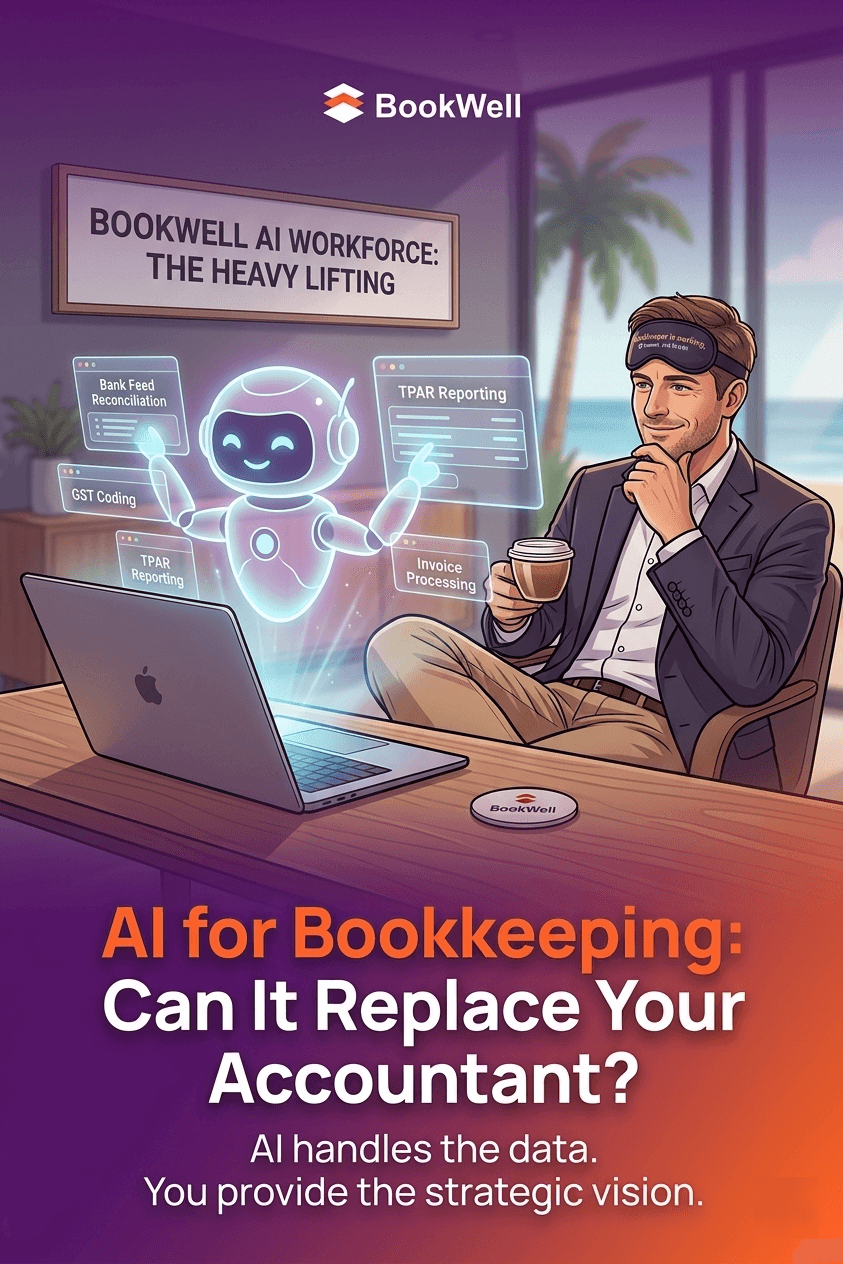
AI bookkeeping excels at automating repetitive tasks like transaction categorization, bank reconciliation, and invoice processing—but it cannot replace the strategic judgment, tax planning expertise, and contextual decision-making that accountants provide.
AI-powered platforms like BookWell automate data entry, flag anomalies, and generate financial reports in real-time, freeing accountants to focus on advisory services rather than manual bookkeeping. However, complex scenarios involving tax law interpretation, strategic financial planning, and ethical decision-making still require professional human oversight.[4]
AI Bookkeeping Capabilities Comparison
Capability | AI Automation Level | Human Oversight Required | Example Tools |
|---|---|---|---|
Transaction categorization | 90-95% automated | Review flagged items | BookWell, QuickBooks, Xero |
Bank reconciliation | 80-90% automated | Verify unusual transactions | BookWell AI Guardian |
Invoice processing | 85-95% automated | Approve payments | BookWell AI Bookkeeper |
Tax compliance | 50-80% automated | Strategic tax planning required | Professional CPA + AI tools |
Financial reporting | 70-85% automated | Interpret results, strategic decisions | BookWell, AI-native platforms |
Audit preparation | 40-60% automated | Professional judgment essential | Human accountant required |
What AI Bookkeeping Does Exceptionally Well
Real-Time Transaction Processing and Categorization
AI-powered bookkeeping systems can categorize thousands of transactions in seconds by recognizing spending patterns, matching vendor names, and flagging recurring charges.[4]
BookWell's line-by-line transaction categorization instantly processes receipts, invoices, and bank statements, allocating every entry to the proper account and significantly reducing errors.[5] This level of automation transforms tasks that once required hours of manual data entry into seconds of processing time.
Modern AI bookkeeping platforms achieve 95%+ accuracy rates in preparing standard financial statements when properly implemented.[2] The technology continuously learns from corrections, improving categorization accuracy over time without requiring manual retraining.
Automated Compliance and Risk Detection
BookWell integrates directly with official government databases to maintain real-time compliance, flagging ABN and GST alerts to ensure supplier details are valid and up-to-date.[5]
AI excels at continuously scanning for anomalies like duplicate charges, transactions that don't match bank feeds, or amounts that deviate from contract terms. Organizations implementing AI-powered bookkeeping systems achieve 60-80% reductions in processing errors through automated validation and real-time compliance checking.[2]
The technology provides ATO benchmarking criteria analysis, comparing client tax data against official benchmarks and identifying risks before an audit begins. Every action is logged for automated audit tracking, ensuring complete transparency throughout the financial workflow.
Predictive Cash Flow and Financial Forecasting
AI analyzes historical cash flow data to forecast financial positions 30 to 90 days ahead, identifying seasonal patterns and alerting businesses to potential shortfalls before they materialize. AI-driven forecasting is estimated to be 30-50% more accurate than traditional methods.[2]
BookWell consolidates and analyzes financial data in real time, providing proactive recommendations for cash flow optimization and cost-saving insights without waiting for end-of-month reports.[5] This capability transforms reactive bookkeeping into proactive financial management.
Massive Time Savings on Routine Work
Some firms report over 80% automation of individual tax return preparation, while businesses using AI-powered accounting tools save an average of 12 hours each month on bookkeeping tasks.[6][4]
These time savings allow accountants to reallocate capacity toward higher-value activities like advisory services and strategic planning. Monthly close cycles shrink from weeks to days, with many companies moving to daily or real-time reporting capabilities.[2]
Where AI Bookkeeping Falls Short
Complex Tax Strategy and Interpretation
AI hits its limits when accounting requires judgment, context, or strategic thinking—determining whether a $2,000 electronics purchase should be categorized as "Office Supplies" or "Equipment" requires understanding what was purchased and how it will be used.[4]
Tax laws change frequently, and understanding how new regulations apply to specific business situations requires professional expertise. Growth decisions like whether to capitalize an expense, how to structure a new business entity, or when to time major purchases for tax advantage depend on contextual reasoning AI cannot replicate.
While AI can organize and track potentially deductible expenses throughout the year, determining whether specific expenses actually qualify for deductions under current tax law requires a CPA's professional judgment. This is why BookWell emphasizes that businesses still need their accountant—but for high-value work rather than data entry and reconciliation.[3]
Ethical Decision-Making and Professional Judgment
More than two-thirds of accounting professionals (72%) worry that generative AI could produce errors or reach incorrect decisions, highlighting the need for careful review and strong oversight of outputs.[1]
AI performs best on routine, structured tasks, but accounting work that demands nuanced understanding, collaboration, or ethical decision-making continues to rely on professional human judgment. The technology cannot assess the ethical implications of financial decisions, understand stakeholder relationships, or navigate the gray areas that characterize real-world business scenarios.
As the CPA.com 2025 AI in Accounting Report emphasizes, "Trust is not built overnight. AI may be capable of handling tasks autonomously, but the profession must move at the speed of confidence, not just capability."[6]
Context-Dependent Business Decisions
AI can analyze historical data and identify patterns, but it lacks understanding of future business plans, strategic initiatives, or market conditions that affect financial decisions. A business owner knows about the new contract starting next month, the equipment purchase planned for Q3, or the seasonal hiring that will affect payroll costs—context that AI cannot access or interpret.
Human judgment adjusts AI projections based on real-world context, turning raw data into actionable decisions. This is why platforms like BookWell are designed to ask for confirmation when the AI detects ambiguous transactions, maintaining 100% human control over final approval.[3]
Data Quality Dependencies
Weak inputs lead to weak outputs. AI learns from historical data, so if existing categorizations are inconsistent or inaccurate, AI will replicate those mistakes at scale. Data quality issues cause 63% of early AI project delays in finance departments.[2]
The technology requires clean, consistent data to function effectively. Businesses must invest in proper setup and training periods to ensure AI systems learn correct categorization patterns from the start.
How BookWell Balances AI Automation with Human Oversight
BookWell operates on a "human-in-the-loop" model where AI agents handle routine bookkeeping autonomously, but never guess when uncertain—they draft queries and ask for confirmation, just like a human staff member.[3]
This approach addresses the core limitation of AI bookkeeping: the need for professional judgment in ambiguous situations. BookWell's AI Guardian checks every invoice against ATO rules (GST, ABN) to ensure BAS is always lodgment-ready, while maintaining human oversight for final approval.[3]
The platform's zero-configuration design allows accountants to upload files directly, with the system handling sorting, classification, and reconciliation automatically. BookWell learns business rules from historical data without requiring complex coding or training, adapting to existing workflows over time.[5]
At $14.25 per month with unlimited transactions, unlimited invoices, and unlimited users, BookWell delivers enterprise-grade finance capabilities at a fraction of traditional bookkeeping costs.[3] The platform offers a 30-day free trial with no credit card required, allowing businesses to test the AI workforce before committing.
The Future: Augmentation, Not Replacement
The strategic imperative is no longer whether to adopt AI—it's how quickly and thoughtfully firms can transition to augmented models where AI handles volume, speed, and consistency while human expertise covers judgment calls, strategic decisions, and quality control.[6]
SMEs are driving the next wave of AI adoption, with the SME segment dominating 68% of the global AI accounting market and growing at 44.6% CAGR.[2] Cloud infrastructure, APIs, and subscription pricing models have made advanced AI accessible to businesses that once couldn't afford enterprise-grade automation.
The accounting profession is not being replaced—it's being redefined. AI fluency is becoming a baseline requirement, with new roles emerging like AI operations managers and AI QA reviewers. Early career professionals now focus on developing "AI oversight" capabilities, learning to interpret AI outputs with professional skepticism and apply strategic judgment where technology falls short.
As one industry expert noted, "You're going to do more, better and differently. This means you'll be able to take on more client advisory service engagements. On one hand, you'll have freed up resources to focus on these engagements. On the other hand, AI will enable you to automate some of the tasks associated with them."[6]
Best Practices for Implementing AI Bookkeeping
Start with Clean Data and Clear Rules
Ensure existing categorizations are accurate before implementing AI. Create clear categorization rules upfront for common transaction types, use consistent vendor names so the system can recognize patterns, and connect all bank and credit card accounts to give the AI a complete picture.
Take time to accurately categorize the first two to three months of transactions during the training period. This investment teaches the AI to categorize future transactions correctly and pays dividends in long-term accuracy.
Build a Regular Review Habit
Schedule weekly reviews of AI-categorized transactions—even 15 to 20 minutes is enough to catch errors, correct miscategorizations, and keep the system learning from feedback. Don't wait until month-end or tax season to check the AI's work.
Pay attention to patterns in the AI's errors. If it consistently miscategorizes certain transaction types, update rules or add custom categorizations. The correction-and-learning loop makes AI tools smarter over time.
Know When to Bring in Professional Expertise
Complex transactions involving tax law interpretation, significant decisions like revenue recognition or expense capitalization, year-end adjustments, audit preparation, and strategic financial planning all benefit from a trained accountant's expertise.
BookWell handles the data entry, reconciliation, and compliance checking, giving accountants clean, perfect data so they can focus on tax planning and advisory services rather than fixing errors.[3]
Choose AI-Native Platforms Over Retrofitted Solutions
Major ERP vendors have started embedding AI into legacy systems, but these capabilities are bolted onto architecture built before modern AI development. AI-native platforms like BookWell are built from day one around AI-powered accounting, enabling deeper automation and more intelligent insights than retrofitted enterprise systems.[2]
FAQ
Can AI bookkeeping completely replace my accountant?
No. AI bookkeeping automates data entry, transaction categorization, and reconciliation, but cannot replace the strategic tax planning, ethical decision-making, and professional judgment that accountants provide. The most effective approach combines AI automation for routine tasks with human expertise for complex decisions. BookWell handles the grunt work so your accountant can focus on high-value advisory services.[3]
What percentage of bookkeeping tasks can AI automate?
AI can automate 80-95% of routine bookkeeping tasks like transaction categorization, bank reconciliation, and invoice processing. However, 50-80% of tax compliance work and 40-60% of audit preparation still require human oversight. Some firms report over 80% automation of individual tax return preparation, but strategic tax planning remains a human-only domain.[6]
How accurate is AI bookkeeping compared to manual bookkeeping?
Properly implemented AI bookkeeping systems achieve 95%+ accuracy rates in preparing standard financial statements and deliver 60-80% reductions in processing errors through automated validation.[2] However, 72% of accounting professionals worry that AI could produce errors in complex scenarios, emphasizing the need for human review.[1]
Will AI bookkeeping eliminate accounting jobs?
No. Only 21% of accounting professionals are concerned that AI might affect their job security because AI cannot handle work requiring nuanced understanding, collaboration, or ethical decision-making.[1] AI is transforming accounting roles from data entry to strategic advisory, with demand growing for professionals who can interpret AI outputs and provide judgment-based guidance.
How much does AI bookkeeping cost compared to traditional bookkeeping?
BookWell costs $14.25 per month (billed yearly) with unlimited transactions, unlimited invoices, and unlimited users, replacing expensive software subscriptions and bookkeeper fees with one flat monthly rate.[3] Traditional bookkeepers typically charge $300-$2,000+ per month depending on transaction volume, making AI bookkeeping significantly more cost-effective for routine tasks while freeing budget for strategic accounting services.
Conclusion
AI bookkeeping represents a fundamental shift in how businesses manage financial operations—not by replacing accountants, but by elevating their role from data processors to strategic advisors. The technology excels at automating the repetitive, structured tasks that consume hours of manual effort, achieving accuracy rates above 95% and delivering time savings that allow firms to reallocate resources toward high-value advisory services.
Yet the limitations are equally clear. AI cannot interpret complex tax law, make ethical decisions, or understand the contextual nuances that define real-world business scenarios. 72% of accounting professionals recognize this gap, understanding that while AI accelerates routine work, it cannot replace the judgment and accountability that underpins professional trust.
BookWell demonstrates the optimal approach: an AI finance workforce that automates bookkeeping, BAS, and payroll with 24/7 precision, while maintaining human oversight for ambiguous transactions and strategic decisions. By handling the grunt work, BookWell gives accountants clean, perfect data so they can focus on what truly matters—tax planning, advisory services, and strategic guidance that drives business growth.
The future belongs to businesses that embrace this partnership model, combining AI's computational power with human expertise to deliver faster, more accurate, and more strategic financial management than either could achieve alone.
Ready to experience AI bookkeeping that works alongside your accountant? Start your 30-day free trial with BookWell—no credit card required.
References
[1] ICAS, "AI can't replace human judgement in accounting, ICAS study shows," 2026. "More than two-thirds of respondents (72%) worry that Gen AI could produce errors or incorrect decisions." https://www.icas.com/news-insights-events/news/press-release/ai-can-t-replace-human-judgement-in-accounting-icas-study-shows
[2] DualEntry, "AI in Accounting: The Complete 2026 Guide," 2026. "The global AI accounting market is projected to reach $10.87 billion in 2026, with SME adoption driving at 44.6% CAGR." https://www.dualentry.com/blog/ai-in-accounting
[3] BookWell, "Hire Your AI Finance Workforce," 2026. "Stop buying software. BookWell provides an AI finance workforce to automate your bookkeeping, bas, and payroll with 24/7 precision." https://www.bookwell.ai/
[4] Business.com, "How Human Intelligence and AI Work Together to Solve Accounting Problems," 2026. "AI can categorize thousands of transactions in seconds by recognizing patterns in your spending." https://www.business.com/articles/ai-humans-solve-accounting-problems/
[5] BookWell Blog, "Smarter Bookkeeping with AI Agents: Why BookWell is Redefining Accounting Automation," 2025. "BookWell instantly processes receipts, invoices, and bank statements with line-by-line transaction categorisation." https://blog.bookwell.ai/2025/09/11/smarter-bookkeeping-with-ai-agents-why-bookwell-is-redefining-accounting-automation/
[6] CPA.com, "2025 AI in Accounting Report," 2025. "Some firms reporting over 80% automation of individual return preparation." https://www.cpa.com/sites/cpa/files/2025-06/2025_AI_in_Accounting_Report.pdf
#AIBookkeeping #AccountingAutomation #BookkeepingSoftware #AIAccounting #SmallBusinessFinance #CloudAccounting #FinancialAutomation #BookWellAI