Introduction
For decades, cloud accounting software has promised automation, yet bookkeepers and business owners still find themselves trapped on a manual data-entry treadmill. Traditional platforms merely act as digital filing cabinets; they require human eyes to read every receipt and human hands to click and match every bank line.
True artificial intelligence is completely upending this dynamic. Modern accounting practices are transitioning away from passive caretaking software to autonomous infrastructure that actually does the heavy lifting.
BookWell 3.0 sits at the forefront of this shift, deploying an autonomous AI Finance Workforce that reduces manual labor hours by up to 70%. But how exactly does a digital brain look at a raw, messy line of banking data and know exactly which expense account it belongs to?
Here is a look behind the curtain at how BookWell's AI bookkeeping engine categorizes transactions automatically—without manual human data prep.
Quick Answer
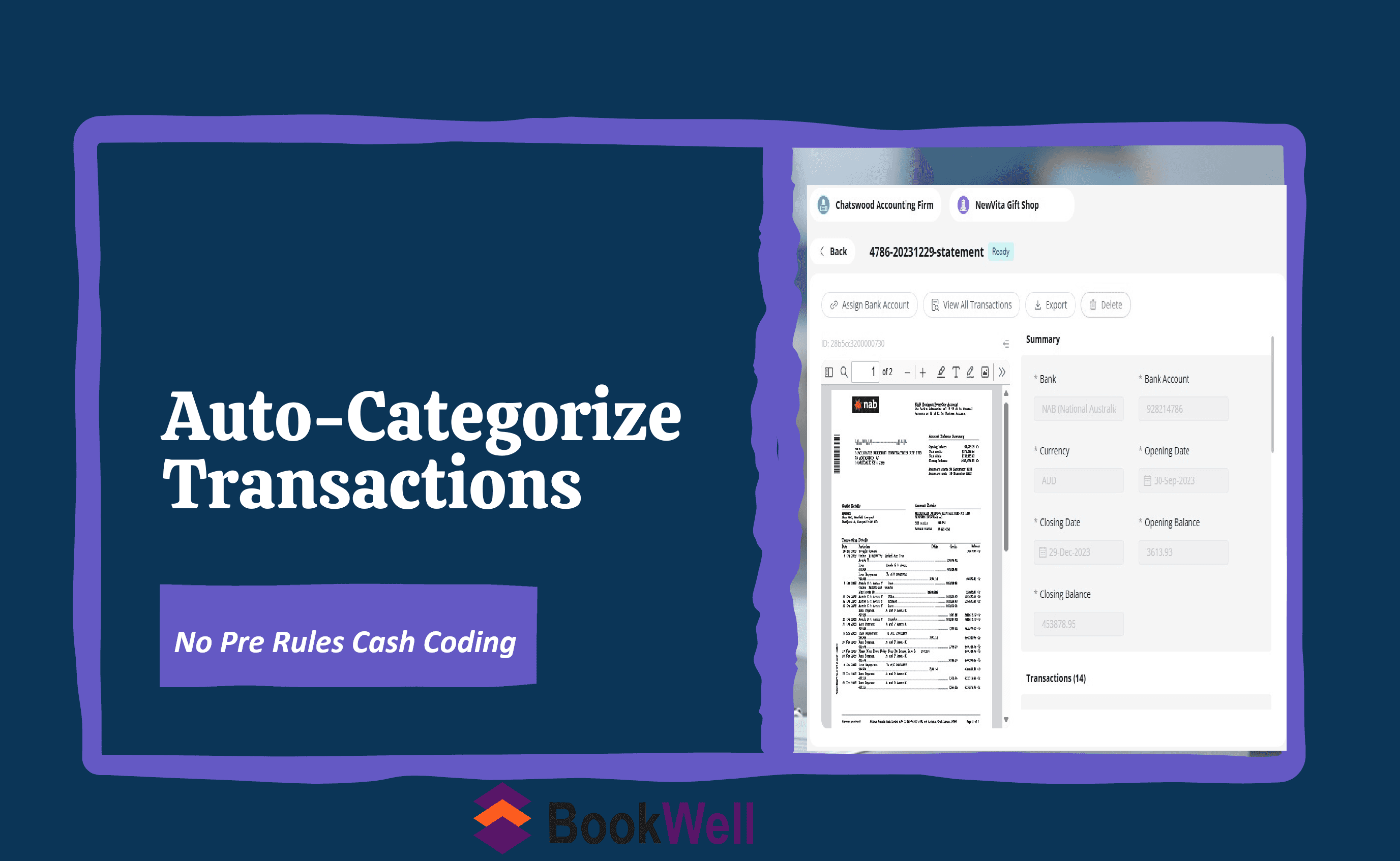
Unlike legacy platforms that rely on humans to manually program thousands of rigid, "if-then" keyword matching rules, BookWell uses advanced natural language processing (NLP) and contextual machine learning. By analyzing a business's historical general ledger data, BookWell's AI Bookkeeper masters unique transactional patterns in just 3 minutes, allowing it to autonomously categorize up to 1,000 complex transactions in 30 minutes with 99% accuracy.
The Architecture of Automation: Brittle Rules vs. Contextual AI
Processing Element | Traditional Cloud Accounting Software | BookWell Autonomous AI Infrastructure |
|---|---|---|
Setup Overhead | Requires staff to spend hours manually typing and updating exact-match bank rules. | Zero Pre-Setup: Learns your firm's entire accounting logic from last year's general ledger in 3 minutes. |
Adaptability | Breaks instantly if a vendor alters their billing string or merchant ID descriptor by a single letter. | Contextual Processing: Uses semantic matching to understand the transactional intent behind the string. |
Data Ingestion | OCR tools extract raw text but push errors to the ledger without checking compliance context. | AI Guardian: Runs 24/7 line-by-line verification to catch personal expenses, missing ABNs, and GST errors. |
Software Cost | Imposes a strict "seat tax," charging scaling businesses higher monthly fees for adding users. | Unlimited Leverage: Standard plans include unlimited users, ledger entries, and document storage at a flat rate. |
Step 1: Ingesting the Historical DNA (The 3-Minute Master)
Before an AI can categorize new, incoming transactions, it must first understand the unique context of your specific business or accounting firm. No two companies code expenses exactly the same way; a computer monitor might be an "Office Expense" for a local bakery, but "Cost of Goods Sold (COGS)" for an IT reseller.
Traditional software forces a human team member to manually type out these logic flows rule by rule. BookWell bypasses this entirely through historical pattern replication:
By simply scanning your historical general ledger data, the AI reverse-engineers your past behavior. It maps out how previous bookkeepers handled specific suppliers, localized tax requirements, and internal charting methods. It learns your unique business logic instantly, matching the speed of a junior team member who has undergone three weeks of intense, manual training.
Step 2: Semantic Text Parsing and Natural Language Processing
When a live bank feed delivers a transaction, the data is rarely clean. It usually arrives as an obscure string of characters, merchant reference codes, and abbreviations (e.g., SQ *7-ELEVEN BRISBANE QLD).
Legacy cloud accounting tools use simple keyword matching. If your rule looks for "7-Eleven" but the bank feed prints "7Eleven," the automation fails, sending the transaction straight to a manual review queue or a cluttered suspense account.
BookWell processes data using Natural Language Processing (NLP). Instead of hunting for exact text strings, the AI parses the metadata to understand the intent of the line item:
Merchant Identification: It extracts the core business identity from the background noise of terminal IDs and location tags.
Geographic Coding: It cross-references location markers to verify corporate validity.
Semantic Context: It recognizes that "Caltex," "7-Eleven Fuel," and "BP Express" share a similar underlying operational category for a mobile sales team, matching them accurately based on context rather than rigid rules.
Step 3: Deep Line-Item Extraction via The Vault
Bank feeds only tell half the story; they show how much money left the account, but they don't show what was actually purchased. True automation requires tying bank feeds directly to source documents.
When clients drag-and-drop receipts or forward bills to their automated email-in mailboxes, the documents land securely inside The Vault. BookWell’s machine learning models don't just execute basic OCR to look at the total amount; they run deep line-item extraction.
If a bill from an office supply store contains both printing paper and a new desktop computer, the AI reads the individual item descriptions. It understands that these must be broken apart, automatically splitting the single transaction into separate ledger lines: coding the paper directly to your P&L Report as an operating expense, and capitalizing the computer onto your Trial Balance as an asset.
Step 4: The AI Guardian and Real-Time Risk Auditing
Automated transaction mapping is useless if the system blindly codes errors into your official ledger. This is why unstructured, generic AI tools create severe compliance risks, often forcing staff to spend 4 to 10 hours a week executing retrospective cleanup work.
To insulate your practice from compliance shocks, BookWell deploys a dedicated, real-time risk layer: The AI Guardian.
As the bookkeeping engine categorizes lines, the AI Guardian operates side-by-side in the background, executing continuous pre-auditing checks. It automatically runs live checks to flag missing ABNs, intercept double-payments, and catch non-compliant personal expense crossovers before they hit your official accounts. If a transaction looks anomalous, the agent isolates it for human review, ensuring your data preparation for quarterly BAS reporting remains completely accurate and pristine.
Step 5: Continuous Feedback Loops and Autonomous Chasing
What happens if a transaction arrives on the bank feed, but the supporting invoice is nowhere to be found? In a traditional accounting workflow, this creates a frustrating "stop-start" logjam. Staff must stop what they are doing, flag the line, and spend hours chasing down the client via manual email trails.
BookWell removes this operational bottleneck entirely through the AI Practice Manager:
While the bank line is safely isolated, the system independently manages automated follow-up loops with the client until the missing document is uploaded. Once the document hits The Vault, the AI instantly reconciles the line, seamlessly pushing the updated numbers straight through to your live P&L reports and financial dashboards.
Conclusion: Scalable Practice Capacity
Understanding how AI bookkeeping software categorizes transactions automatically highlights a fundamental truth: relying on manual human clicking to clear standard bank feeds and fix corrupted data tracks is an outdated operational model.
By upgrading your business or accounting firm to BookWell 3.0’s autonomous AI finance workforce, you replace the data-entry grind with real-time financial tracking, absolute compliance control, and effortless scalability. Your team stops acting as low-margin data processors and gains the clear operating capacity needed to deliver high-value, strategic client advisory.
Streamline your accounting workflows and protect your practice margins. Head over to bookwell.ai to book your live demo and discover the power of autonomous bookkeeping today.
#AccountingAI #NoRulesCashCoding #PracticeManagement #AIBookkeeper #FinTechAU #BookWellAI #LiveBetter