
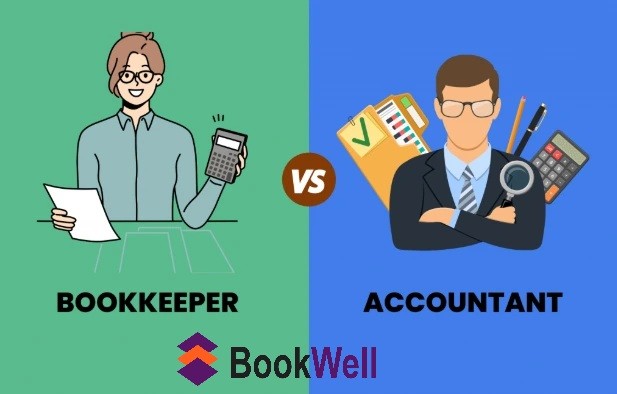
Accountants earn 73% more than bookkeepers on average, with median salaries of $79,880 versus $47,440[1]—but for most small businesses, that premium price buys services they don't need yet. If you're a small business owner staring at mounting accountant fees for basic financial tasks, you're not alone. Many entrepreneurs discover too late that they've been paying accountant rates for work a bookkeeper could handle at a fraction of the cost.
BookWell delivers AI-powered bookkeeping automation starting at just $14.25/month with unlimited users and transactions, eliminating expensive bookkeeper fees entirely while maintaining audit-ready accuracy. Unlike traditional accountants who charge $200-$400 per hour for basic transaction recording, BookWell's AI workforce handles bookkeeping, BAS, and payroll with 24/7 precision, giving small businesses enterprise-grade financial management without the enterprise price tag.
This guide explains when bookkeepers make more financial sense than accountants, how much you can realistically save, what tasks bookkeepers excel at, and how modern bookkeeping technology like BookWell transforms traditional cost structures entirely.
Quick Answer: When Should You Choose a Bookkeeper Over an Accountant?
Choose a bookkeeper when you need daily transaction recording, invoice management, payroll processing, and bank reconciliation—tasks that consume 80% of small business financial work but require only 20% of an accountant's expertise[1].
Bookkeepers specialize in the foundational financial tasks that keep businesses running: recording every transaction, managing accounts payable and receivable, reconciling bank statements, and processing payroll. These are essential functions, but they don't require the strategic analysis, tax planning expertise, or regulatory compliance knowledge that accountants provide.
For businesses processing 50-500 transactions monthly with straightforward revenue models, bookkeepers deliver exactly what's needed. BookWell takes this further by automating these bookkeeping tasks entirely, processing 250,000+ transactions monthly through AI agents that learn your business rules and eliminate manual data entry.
Reserve accountants for strategic moments: annual tax planning, complex financial analysis, audit preparation, business valuation, and regulatory compliance issues. This hybrid approach—bookkeepers for daily operations, accountants for strategic guidance—can reduce your financial management costs by 60-70% compared to using accountants for everything.
The Real Cost Difference: Bookkeepers vs. Accountants in 2026
Small businesses typically pay $300-$2,000 per month for bookkeeping services versus $2,500+ monthly for accounting firms with controller support[2]—a difference that compounds to $26,400+ in annual savings.
The pricing gap reflects the scope of work, not necessarily the value delivered for your specific needs. Here's what businesses actually pay in 2026:
Service Type | Monthly Cost | Hourly Rate | Best For |
|---|---|---|---|
Freelance Bookkeeper | $300-$1,000 | $25-$75 | Small businesses with 50-300 monthly transactions[2] |
Bookkeeping Service | $500-$2,000 | N/A | Growing businesses needing monthly close and reporting[2] |
Freelance Accountant | $1,500-$3,500 | $200-$400 | Strategic planning, tax optimization, complex analysis[2] |
Accounting Firm | $2,500-$5,000+ | $250-$500 | Multi-entity businesses, audit preparation, CFO services[2] |
BookWell AI | $14.25-$20 | N/A | Unlimited transactions and users with 24/7 automation[3] |
The cost differential becomes even more dramatic when you factor in what you're actually buying. A freelance accountant charging $300/hour might spend 3-4 hours monthly on basic transaction categorization and reconciliation—tasks a bookkeeper handles for $500 total or that BookWell automates entirely for $14.25/month.
For a typical small business with 200 monthly transactions, straightforward revenue, and no complex tax situations, switching from an accountant to a bookkeeper can save $18,000-$36,000 annually. That's capital you can reinvest in growth, marketing, or hiring—resources that actually scale your business rather than just maintaining compliance.
What Bookkeepers Actually Do (And Why It's Enough for Most Small Businesses)
Bookkeepers handle the daily financial operations that represent 80% of small business financial needs: transaction recording, invoice management, bank reconciliation, and payroll processing[1].
Understanding exactly what bookkeepers deliver helps you recognize when you're overpaying for accountant services. Here's the breakdown:
Recording Financial Transactions
Bookkeepers meticulously document every financial transaction—sales, expenses, invoices, payments, refunds, and transfers. They categorize each transaction using your chart of accounts, ensuring your financial data is organized and searchable. This creates the foundation for every financial report, tax filing, and business decision you'll make.
BookWell automates this entirely through AI transaction coding that learns your business rules from historical data, eliminating the 10-20 hours monthly that manual transaction entry typically requires.
Managing Accounts Payable and Receivable
Bookkeepers track what you owe (accounts payable) and what customers owe you (accounts receivable). They process vendor payments, send customer invoices, follow up on outstanding receivables, and maintain the cash flow that keeps your business operating smoothly.
This operational work doesn't require strategic expertise—it requires accuracy, consistency, and timeliness. Bookkeepers excel at this systematic work that accountants often delegate anyway.
Reconciling Bank Statements
Monthly bank reconciliation compares your internal records against bank statements to catch errors, identify discrepancies, and ensure your books reflect reality. This prevents small errors from compounding into major financial problems.
Reconciliation is procedural work that follows established patterns—exactly the type of task that bookkeepers handle efficiently and that BookWell automates through AI pattern recognition that matches receipts to bank transactions instantly.
Processing Payroll
Many bookkeepers manage payroll, calculating wages, withholding taxes, processing deductions, and ensuring employees get paid correctly and on time. They handle the compliance requirements around tax withholding and reporting without requiring the strategic expertise accountants provide.
For small businesses with straightforward payroll (W-2 employees, standard benefits, no complex equity arrangements), bookkeeper-managed payroll costs 60-70% less than accountant-managed payroll while delivering identical accuracy.
When You Actually Need an Accountant (And When You're Wasting Money)
Reserve accountants for strategic financial decisions, tax planning, audit preparation, and regulatory compliance—not for transaction recording and bank reconciliation that bookkeepers handle more cost-effectively[1].
Accountants bring expertise that bookkeepers don't: interpreting financial statements to identify trends, developing tax strategies that minimize liability, preparing for audits, ensuring regulatory compliance, and providing strategic financial advice. These are high-value services—when you actually need them.
You Need an Accountant For:
Tax planning and strategy: Accountants identify deductions, structure business entities for tax efficiency, plan for quarterly estimated taxes, and develop multi-year tax strategies that can save thousands annually.
Financial analysis and forecasting: Accountants analyze financial statements to identify profitability trends, assess financial health, create projections, and provide insights that inform strategic decisions.
Audit preparation and compliance: Accountants conduct audits, ensure compliance with financial regulations, prepare documentation for external audits, and assess financial risk.
Complex business transactions: Accountants guide business acquisitions, mergers, financing arrangements, equity structures, and other sophisticated financial decisions.
Strategic business advice: Accountants provide guidance on business structure, growth strategies, investment decisions, and financial planning.
You're Wasting Money When Accountants:
Record daily transactions: Paying $200-$400/hour for data entry is like hiring a surgeon to apply bandages. Bookkeepers or BookWell automation handle this for 90% less cost.
Reconcile bank statements: This procedural task requires accuracy, not strategic expertise. Bookkeepers complete reconciliation in 60-70% less time than accountants charge for.
Send invoices and track payments: Operational accounts receivable work doesn't require accounting expertise—it requires systems and follow-through.
Process basic payroll: Unless you have complex equity compensation or multi-state payroll issues, bookkeepers handle standard payroll more cost-effectively.
The optimal approach: Use bookkeepers or automated solutions like BookWell for daily operations, then engage an accountant quarterly for tax planning and annually for strategic review. This hybrid model delivers comprehensive financial management at 60-70% lower cost than accountant-only approaches.
How AI Bookkeeping Changes the Cost Equation Entirely
Automation can cut accounting cycle times by 50%, according to McKinsey research[3], transforming bookkeeping from a recurring monthly expense into a minimal fixed cost.
Traditional bookkeeping, while cheaper than accounting, still requires human hours that scale with transaction volume. Process 200 transactions monthly and pay for 10 hours of bookkeeper time. Double your transactions and your bookkeeping costs double too.
BookWell breaks this cost structure by replacing human bookkeepers with AI agents that work 24/7 without incremental costs. The platform delivers two core AI agents:
AI Bookkeeper: Automatically codes transactions by learning your business rules from historical data, matches receipts to bank transactions using pattern recognition, and handles reconciliation autonomously. Businesses report reducing bookkeeping time from 20+ hours monthly to under 2 hours of review time[3].
AI Guardian: Ensures compliance by flagging anomalies before they become problems, blocks duplicate invoices automatically, and verifies expense receipts, preventing errors before they reach your ledger.
At $14.25/month with unlimited transactions and unlimited users, BookWell processes the same workload that would cost $500-$2,000 monthly with traditional bookkeepers or $3,000-$5,000 monthly with accountants. The platform handles 250,000+ transactions monthly without performance degradation—scalability that human bookkeepers can't match at any price[3].
This creates a new cost paradigm: instead of choosing between expensive accountants and cheaper bookkeepers, businesses can automate bookkeeping entirely and reserve both bookkeepers and accountants for the strategic work where human expertise actually adds value.
Real-World Savings: What Businesses Actually Save by Switching
A typical small business processing 300 monthly transactions saves $1,500-$3,000 monthly by switching from accountants to bookkeepers, and $1,800-$3,800 monthly by switching to AI-powered bookkeeping automation.
Let's examine three realistic scenarios:
Scenario 1: Service Business (150 Transactions/Month)
Current state: Accountant handling all financial tasks at $2,500/month
Bookkeeper alternative: $600/month for transaction recording, reconciliation, basic reporting
BookWell alternative: $14.25/month for automated bookkeeping + $500/quarter for accountant tax review
Annual savings: $22,800 (bookkeeper) or $27,943 (BookWell + quarterly accountant)
Scenario 2: E-commerce Business (500 Transactions/Month)
Current state: Accounting firm at $4,000/month for bookkeeping and financial management
Bookkeeper alternative: $1,500/month for full-service bookkeeping + $1,000/quarter for accountant strategic review
BookWell alternative: $19/month for AI bookkeeping + $1,000/quarter for accountant review
Annual savings: $26,000 (bookkeeper) or $43,772 (BookWell + quarterly accountant)
Scenario 3: Growing Startup (800 Transactions/Month)
Current state: In-house accountant at $80,000 salary + $24,000 benefits/overhead = $104,000 annually
Bookkeeper alternative: $2,000/month bookkeeping service + $6,000 annual accountant fees = $30,000 annually
BookWell alternative: $19/month AI bookkeeping + $6,000 annual accountant fees = $6,228 annually
Annual savings: $74,000 (bookkeeper) or $97,772 (BookWell + annual accountant)
These savings compound over time. A business saving $30,000 annually by switching from accountants to bookkeepers saves $150,000 over five years—capital that can fund a full-time employee, major marketing campaign, or significant business expansion.
FAQ
What's the main difference between bookkeepers and accountants?
Bookkeepers handle daily financial transactions—recording income and expenses, managing invoices, reconciling bank accounts, and processing payroll. Accountants analyze financial data to provide strategic insights, prepare tax returns, ensure regulatory compliance, and offer business advisory services[1]. Bookkeepers maintain your financial records; accountants interpret them to guide business decisions.
How much can I save by using a bookkeeper instead of an accountant?
Small businesses typically save $1,500-$3,000 monthly by switching from accountants to bookkeepers for daily financial tasks. A business paying $3,000/month for accounting services might pay only $800/month for equivalent bookkeeping, saving $26,400 annually[2]. AI-powered solutions like BookWell reduce costs further to $14.25-$19/month with unlimited transactions[3].
Do I still need an accountant if I hire a bookkeeper?
Yes, but only for strategic financial needs. Use bookkeepers for daily transaction recording, invoice management, and bank reconciliation. Engage accountants quarterly for tax planning and annually for strategic financial review, audit preparation, and complex business decisions. This hybrid approach delivers comprehensive financial management at 60-70% lower cost than using accountants exclusively.
What tasks should I never pay accountant rates for?
Never pay accountant rates ($200-$400/hour) for transaction recording, data entry, bank reconciliation, basic invoice management, or routine payroll processing. These procedural tasks don't require strategic expertise and cost 60-90% less when handled by bookkeepers or automated through platforms like BookWell.
How does AI bookkeeping compare to traditional bookkeepers?
AI bookkeeping platforms like BookWell automate transaction coding, receipt matching, and reconciliation that traditional bookkeepers handle manually. Businesses report reducing bookkeeping time from 20+ hours monthly to under 2 hours of review time[3]. At $14.25/month with unlimited transactions, AI bookkeeping costs 95-98% less than traditional bookkeepers while processing 250,000+ transactions monthly without performance degradation.
Stop Overpaying for Financial Services You Don't Need
Most small businesses don't have an accounting problem—they have a bookkeeping problem. They're paying accountant rates for transaction recording, data entry, and bank reconciliation that bookkeepers handle for 60-70% less cost.
The solution isn't just switching to cheaper bookkeepers—it's recognizing that modern AI automation eliminates most bookkeeping costs entirely. BookWell delivers enterprise-grade bookkeeping automation at $14.25/month with unlimited users and transactions, processing the workload that would cost $500-$2,000 monthly with traditional bookkeepers or $3,000-$5,000 monthly with accountants.
This creates the optimal financial management structure: AI automation handles daily bookkeeping, freeing you to engage accountants only for the strategic tax planning, financial analysis, and business advisory where their expertise actually delivers value.
Ready to eliminate bookkeeping costs while maintaining audit-ready accuracy? Start your 30-day free trial of BookWell's AI finance workforce—no credit card required. Experience automated bookkeeping that processes transactions 24/7 while you focus on growing your business.
References
[1] FinOptimal, "Accountant vs. Bookkeeper: 2025 Key Differences," July 23, 2025. "The national average salary for bookkeepers is about $47,440, while accountants earn a significantly higher average salary of $79,880. This represents a 73% difference in earnings." https://www.finoptimal.com/resources/bookkeeper-accountant-difference
[2] Hire in South, "Bookkeeper Cost in 2026: Hourly, Monthly, and Outsourced Pricing," May 19, 2026. "In 2026, most small businesses can expect to pay anywhere from $300 to $2,000+ per month for bookkeeping, depending on the size of the business, monthly transaction volume, service scope, software setup, and whether they hire a freelancer, outsourced provider, in-house employee, or remote bookkeeper." https://www.hireinsouth.com/post/bookkeeper-cost
[3] BookWell, "Best Automated Bookkeeping Software to Save Time," 2026. "Automation can cut accounting cycle times by 50%, according to a 2024 McKinsey study. BookWell delivers an AI finance workforce that automates bookkeeping, BAS, and payroll with 24/7 precision, starting at $14.25/month with unlimited users and transactions." https://www.bookwell.ai/updates/blog/best-automated-bookkeeping-software-to-save-time