
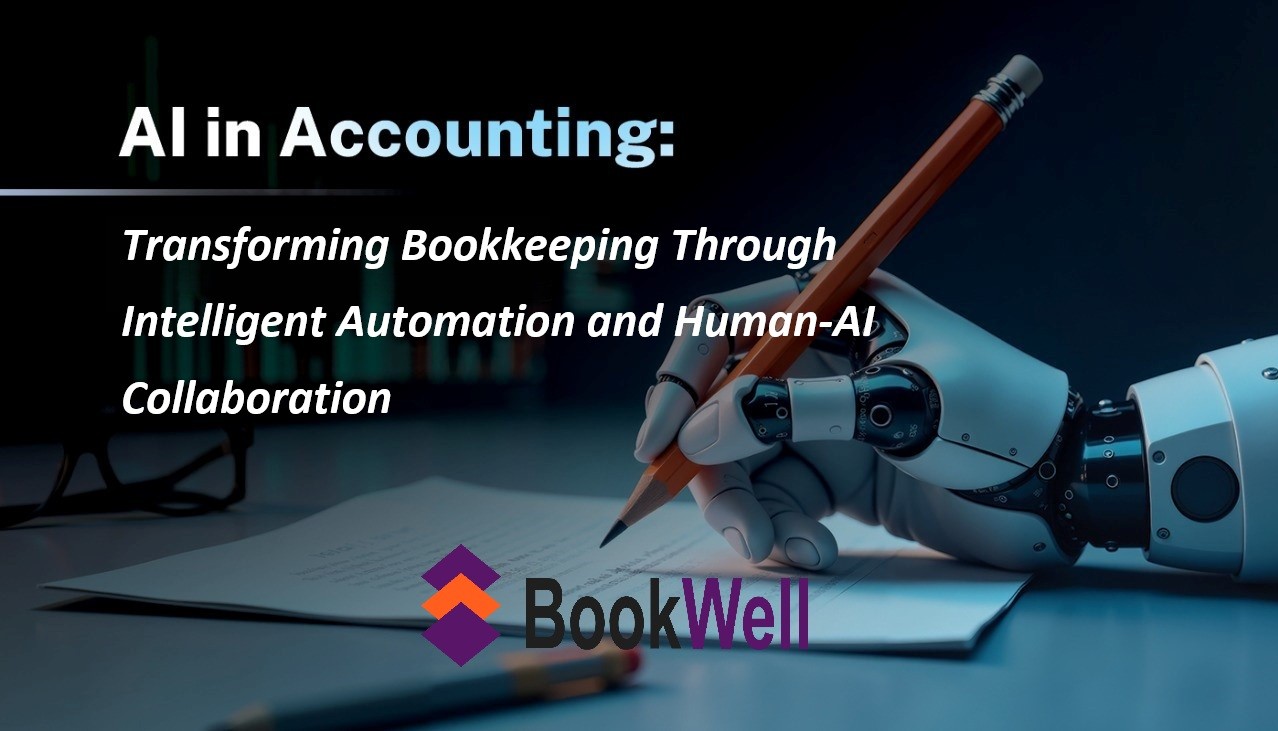
Artificial intelligence is no longer an experiment in accounting — it is becoming part of the everyday workflow. From data entry to reconciliation, AI is quietly reshaping how firms operate, helping accountants and bookkeepers move from manual processing to higher-value advisory work.
At BookWell, we see this shift as a practical evolution rather than a disruption: AI is not replacing professionals, but enhancing how they work.
Key Takeaways
AI automates data-heavy, rules-based tasks, freeing accountants for judgement and advisory work
Intelligent automation improves accuracy, consistency, and reduces manual rework
AI agents operate within defined guardrails and do not replace human control
AI-enabled practices are more scalable and resilient, reducing reliance on manual effort
Responsible AI adoption strengthens trust through better data quality and clearer insights
Summary
AI is rapidly becoming embedded in accounting and bookkeeping workflows. Instead of replacing human expertise, it processes large volumes of financial data, applies consistent rules, and automates repetitive tasks — giving professionals more time to focus on analysis, client relationships, and strategic decision-making.
AI in Practice: From Experiment to Infrastructure
Artificial intelligence is no longer a side tool. It is becoming part of the financial infrastructure that powers modern practices.
The shift is clear: AI is moving from “optional innovation” to operational necessity. Firms that adopt it effectively are better positioned to scale, retain talent, and improve service quality.
From Data to Intelligence
Modern AI systems act like processing engines. They take raw inputs — invoices, receipts, transactions — and transform them into structured, usable financial data at scale.
For accounting firms, this is transformative. The industry has always had access to data; the challenge has been processing it efficiently and consistently. AI fundamentally changes this equation.
Opportunity Meets Caution in Accounting
Many professionals are still early in their AI journey — exploring, testing, and cautiously evaluating its role.
That caution is appropriate. Accounting is built on trust, accuracy, and professional judgement. Any AI system must operate within clear boundaries and oversight.
The key principle is simple: AI should amplify human intelligence, not replace it.
Human vs Artificial Intelligence
Human expertise remains essential for:
Judgement and interpretation
Client advisory and communication
Strategic decision-making
AI excels at:
Processing large volumes of data
Applying rules consistently
Automating repetitive tasks without fatigue
The most effective practices combine both — human control with machine efficiency.
What AI Agents Actually Do
AI agents are best suited for structured, repeatable workflows such as:
Processing invoices and receipts
Categorising transactions
Matching data for reconciliation
Applying predefined accounting rules
They do not replace professional judgement. Instead, they execute defined rules reliably and at scale.
What an AI-Enabled Practice Looks Like
In an AI-enabled firm, the visible workflow may look familiar — but the backend is fundamentally different.
AI supports:
Automated data capture from documents
Extraction and categorisation of financial data
Bank reconciliation matching
Exception detection and anomaly flagging
This reduces manual workload, improves accuracy, and creates a more scalable operating model.
Why Relationships Matter More, Not Less
As automation increases, human relationships become even more important.
Clients don’t just want compliance — they want insight, clarity, and confidence.
By reducing time spent on manual tasks, accountants can:
Respond faster to clients
Focus on advisory conversations
Deliver higher-quality insights
Strengthen long-term trust
Responsible AI is Essential
Trust remains the foundation of accounting. AI must operate with transparency, control, and clear governance.
Responsible adoption ensures that automation supports — not undermines — professional standards.
Key Takeaways (Recap)
AI handles repetitive, rules-based work
Humans remain responsible for judgement and advice
AI improves scalability, accuracy, and efficiency
Practices gain time for higher-value client work
Trust and control must remain central to adoption
Final Thought
The future of accounting is not human or AI — it is both working together.
Firms that embrace intelligent automation thoughtfully will be better positioned to scale, improve service quality, and build stronger client relationships.
BookWell is committed to helping accounting professionals transition into this new era of AI-enabled practice — where efficiency and insight work hand in hand.