BOOKWELL AI BOOKKEEPER · PRACTICE GUIDE
Why most bookkeeping automation still leaves you doing the bookkeeping
A receipt scanner without context still leaves your team making the bookkeeping decisions. BookWell connects extraction, coding, reconciliation and financial checks so accountants can focus on the work that needs their judgement.

It is Tuesday morning, three weeks out from BAS lodgement. You open a client file expecting a routine review and find hundreds of unreconciled bank-feed lines, unanswered client queries and a suspense account holding everything from a Bunnings purchase to a director’s personal takeaway order.
The client pays for cloud accounting software and receipt apps. Their records are described as automated, yet your senior bookkeeper still has to untangle merchant rules, chase missing invoices and revisit GST treatments that looked plausible on a review screen. This is an illustrative practice scenario, but the underlying problem is familiar: capturing data is only the beginning.
Many tools make one step faster, such as reading a receipt or suggesting an account from a merchant name. If the next person still has to reconstruct the transaction, the work has moved rather than disappeared.
An AI Bookkeeper earns its place by connecting the whole loop: the source document, accounting treatment, bank transaction and evidence needed for review. It should also make uncertainty visible instead of turning a guess into an apparently finished entry.
Four bottlenecks inside automated bookkeeping
The remaining work usually sits between systems: missing evidence, coding without context, GST inconsistencies and records that are difficult to trace.
1. Unmatched source documents
A PDF invoice lands in an inbox, a receipt photo stays on a phone and a bank-feed line appears later with a shortened merchant description. Without a connection between these records, the team has to establish whether a bill was already entered, which payment settled it and whether supporting evidence is still missing.
2. Context-blind coding
A merchant name is a clue, not an accounting conclusion. An Apple transaction could be a subscription, a handset or a different purchase altogether. The invoice line items, business purpose and client’s chart of accounts matter. A familiar supplier can still produce an unfamiliar transaction that deserves a question.
3. GST inconsistencies that surface at BAS time
A default GST code can conceal differences between taxable, GST-free, input-taxed and private expenditure. Mixed supermarket purchases, overseas subscriptions and supplier registration questions need the underlying document and business context. A bank description alone cannot establish the correct treatment.
4. A missing explanation behind the number
When a ledger balance looks unusual months later, the reviewer needs more than an amount and account code. They need the source invoice, the matching payment and an explanation of any judgement. Without that context, each review becomes another investigation.
What BookWell’s AI Bookkeeper does differently
Ben connects document capture, transaction coding and reconciliation. Grace adds financial checks, while your team reviews the evidence and resolves exceptions.
BookWell’s AI Bookkeeper is part of a connected AI Finance Workforce for Australian accounting firms and businesses. The value comes from bringing preparation and checking together, rather than treating receipt capture as a finished bookkeeping task.
The comparison below describes a basic standalone OCR or merchant-rule workflow. Individual accounting products vary; use a representative client file to assess the actual difference in your practice.
Document intake
Basic OCR or merchant rules
Reads document fields; a separate process may be needed to connect them with the ledger.
BookWell workflow
Extracts receipt and invoice details, including line items, with Snap & Go and Batch Mode capture options.
Account coding
Basic OCR or merchant rules
Suggests accounts from fixed merchant or keyword rules.
BookWell workflow
Supports categorisation using document details, transaction context and the client’s bookkeeping setup.
Bank reconciliation
Basic OCR or merchant rules
Exact-match rules can leave discrepancies for manual investigation.
BookWell workflow
Connects documents and bank transactions to support matching and reconciliation, with differences reviewed by your team.
Financial checks
Basic OCR or merchant rules
A captured amount or suggested tax code may still need a separate check.
BookWell workflow
Grace supports checks for potential duplicates, unusual transactions, supplier information and GST inconsistencies.
Review handover
Basic OCR or merchant rules
The reviewer may need to find the evidence in another inbox or app.
BookWell workflow
Brings source information and accounting work into a connected process so the reviewer can investigate outstanding items.
A high processing volume is useful only if the result is easy to inspect. The practical test is how much investigation remains, whether genuine exceptions are visible and whether your team can explain the final records.

From source receipt to structured accounting data in BookWell.
Separate routine coding from genuine exceptions
Treat a predictable recurring transaction differently from a purchase that needs business context. The handover should show what needs attention and why.
Automation creates rework when an ambiguous transaction looks indistinguishable from a clean one. A new supplier, an unusual amount or a mixed personal and business purchase should prompt a targeted review, not a confident assumption.
Routine transactions: review for consistency
For recurring costs, compare the supplier, source invoice, bank amount and established account treatment. BookWell’s connected capture, coding and matching workflow helps reduce repeated entry. Your practice determines the review standard and the approval steps appropriate to that client.
Exceptions: ask the specific question
An unresolved item becomes easier to handle when the question is clear: Is this business or private? Is the equipment an asset? Does the invoice contain GST? Which invoices does this deposit settle? Give the client or reviewer the transaction details needed to answer it.
The goal is a smaller, more useful set of review questions. Avoid measuring success by the number of suggestions accepted alone; also look at unresolved transactions, corrections after review and time spent finding evidence.
Build a review trail around every figure
Keep the source document, payment and explanation connected so the next reviewer can understand the transaction without starting again.
Messy bookkeeping is often paid for twice: first when the preparer clears the file, then when the accountant reconstructs it at year-end. A useful review trail answers three questions: what happened, what supports the entry and why was that treatment chosen?
Source evidence: retain the relevant receipt or invoice and check that it belongs to the correct entity and period.
Accounting treatment: record the account classification, GST treatment and any business-use judgement that affects the result.
Payment connection: reconcile the amount with the bank movement and explain differences, part-payments or timing items.
Outstanding questions: make missing documents and unresolved judgements explicit before handing the file to a reviewer.
For a manager or partner, that context makes sign-off more focused. For the year-end accountant, it provides a clearer starting point for preparation. When staff change, the important decisions should remain understandable from the file itself. Ask the BookWell team to demonstrate the record links and review information available in your chosen workflow.

BookWell connects transaction matching and reconciliation with the supporting records.
How the BookWell bookkeeping workflow works
Capture the evidence, prepare the accounting, reconcile the money and review the exceptions before the figures move into reporting.
Set up the client. Confirm the entity, bank connection, chart of accounts, reporting period and the responsibilities of the preparer and reviewer.
Capture documents. Use Snap & Go for receipts as they arrive or Batch Mode for a collection of invoices and receipts. Check unreadable pages and incomplete documents.
Review extraction and coding. Inspect supplier, date, amounts, GST and line items. Apply the client’s business context to unusual purchases or uncertain classifications.
Match and reconcile. Connect source documents to bank transactions. Investigate missing payments, amount differences and records that do not match.
Resolve exceptions and hand over. Use Guardian checks and specific client questions to clear outstanding work. Review the final position before relying on it for reports or BAS preparation.
If your practice keeps the client’s ledger in Xero, BookWell also has a supported document-processing and publishing workflow. Confirm chart-of-accounts mappings and the intended Draft or Awaiting Approval status before publishing processed documents.
Watch BookWell’s AI finance workflow
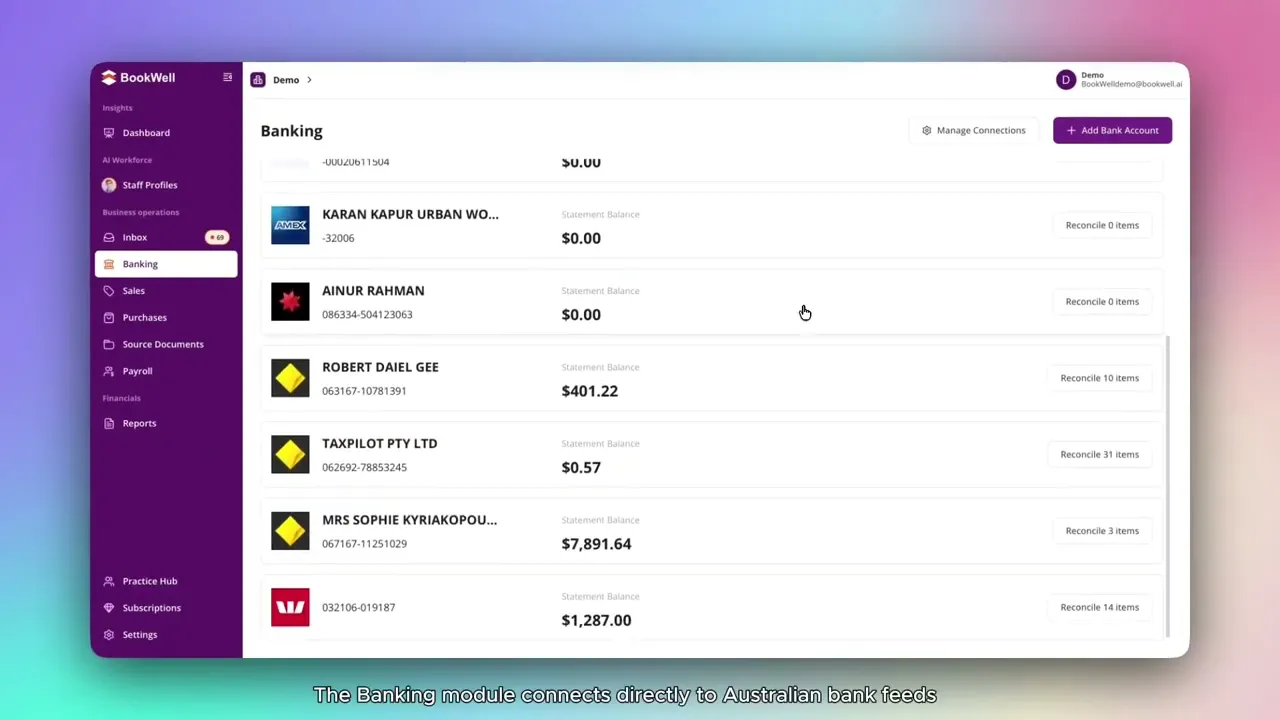
See BookWell’s all-in-one AI finance module in this official product walkthrough.
A BAS review starts before BAS week
Keep document collection and reconciliation moving through the period, then use a defined checklist for the final review.
A well-organised daily or weekly routine reduces the pile-up at lodgement time. Capture receipts while the purchase is familiar, review coding regularly and ask the client about missing evidence before the transaction is forgotten.
Are the relevant bank accounts and reporting periods covered?
Do outstanding transactions and suspense balances have an explanation?
Are potential duplicates resolved and payments matched to the correct records?
Have mixed-use purchases, unusual costs and GST exceptions been reviewed?
Does the responsible reviewer have the supporting evidence needed to complete the next stage?
For GST-credit purposes, a tax invoice is generally required for purchases costing more than A$82.50 including GST, subject to applicable exceptions. Smaller purchases still require supporting records. The right treatment depends on the transaction and the available evidence.
How it helps accountants and bookkeepers
Spend less of the engagement reconstructing transactions and more of it reviewing the file, explaining the numbers and helping the client act.
Protect time inside fixed-fee engagements
Repeated entry, missing-document searches and avoidable corrections consume the same fee. A connected workflow helps the practice identify where preparation can become more consistent and where client behaviour needs to change.
Make review and handover clearer
The reviewer should be able to distinguish prepared work from outstanding questions. Keep evidence and exceptions visible so a senior team member can focus on the decisions that need their experience.
Build a better client conversation
Once the accounting records are reviewed, the conversation can move to cash, margins and what happens next. Bookkeeping quality supports that advice; speed alone does not.
Where BookWell fits—and where your judgement leads
BookWell supports the preparation and checking work. Your practice owns the business context, client relationship and final professional judgement.
Ben, the AI Bookkeeper, connects document capture, transaction coding and bank reconciliation. Grace, the AI Guardian, supports risk and consistency checks. Mia helps with document collection and communication, while Alex supports financial reporting and insight.
The wider platform also includes receivables, payables and payroll workflows. Connecting those activities helps your team understand the records behind incoming and outgoing money without rebuilding the picture for each task.
BookWell does not remove the need to understand the client. Your team still decides how to treat ambiguous purchases, resolves missing evidence and completes the required review and authorisation before a lodgement or payment progresses.
Questions practices ask about AI bookkeeping
Evaluate the workflow on the work your team actually performs, including the exceptions.
Is an AI Bookkeeper the same as a receipt scanner?
Receipt scanning extracts information. Bookkeeping also requires coding, reconciliation, evidence and review. BookWell connects capture with the wider accounting workflow so the extracted data can become useful bookkeeping records.
Do we have to move every client away from Xero?
BookWell supports a Xero document-processing and publishing workflow. Discuss the entity setup, mappings and review status with the team before changing a live client process.
How should we test it in our practice?
Bring a representative file containing ordinary recurring costs as well as a few difficult items. Check the extracted data, coding, matching, exception handling and supporting records. Compare the review work remaining, rather than relying on a headline speed claim.
See BookWell’s AI Bookkeeper on your workflow
Bring a typical client file and the exceptions your team finds hardest. Explore how BookWell connects capture, coding, reconciliation and review in a practical demonstration.